
A Halifax household that used to heat with oil may be adding air conditioning for the first time. A useful annual heat pump estimate shows summer cooling separately so you can see both the new comfort and its electricity cost.
How much is 300 kWh on standard service? At Nova Scotia Power’s standard residential rate of 19.128¢ per kWh, it is $57.38 in energy charges, before tax, rebates and the monthly base charge. Use the same 300 kWh benchmark to compare mini split electricity use in Canada across residential plans.
What about a month of cooling? At an assumed 5 kWh per day, a ductless unit uses 150 kWh in 30 days. That adds $28.69 at the standard rate.
How do I turn that into an annual budget? Count the months you actually cool, heat heavily, or need only a little heat. A January reading cannot tell you how many hours you will cool an upstairs bedroom in July.
Start with the service you want. List the rooms heated in winter, the rooms cooled in summer and any areas that stay on another system. Then request monthly electricity estimates for those defined spaces. The floor plan should remain attached to the worksheet.
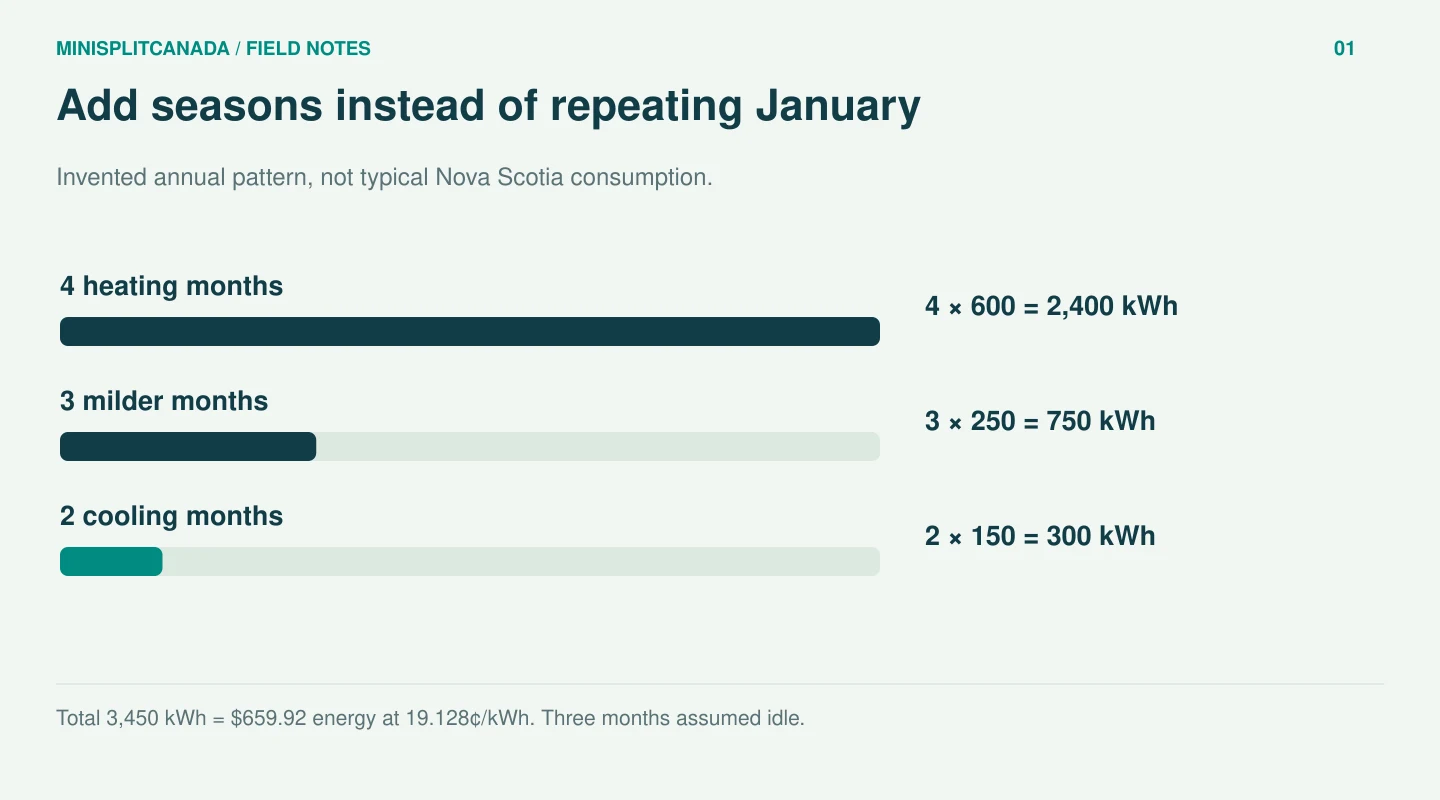
Consider an invented annual pattern: four heating months at 600 kWh each, three milder months at 250 kWh each and two cooling months at 150 kWh each. Assign no mini split use to the remaining three months for this illustration. The annual total is 3,450 kWh, costing $659.92 in energy at the stated rate.
That result is not a forecast for Nova Scotia. It shows why adding distinct periods is better than multiplying 600 kWh by twelve, which would produce 7,200 kWh. Replace every assumed month with a modelled or measured figure for your home.
If your actual equipment uses standby or accessory electricity during nominally idle months, include it rather than forcing those months to zero. Ask what the proposed measurement or estimate includes. A good worksheet makes omissions explicit instead of presenting a deceptively precise annual total.
Nova Scotia Power’s standard residential page lists an energy charge of $0.19128 per kWh and a fixed monthly base charge of $20.08, updated May 1, 2026. These are the standard-service inputs checked for this guide on November 2, 2026.
The energy price applies throughout the day under that standard tariff. Moving consumption to midnight does not automatically earn a lower energy price on this plan. Check the account’s actual tariff before following advice built around off-peak electricity.
The utility separately describes an equipment-based time-of-day plan for customers with electric thermal storage systems, as well as other rate options and pilots. Owning a mini split alone does not establish eligibility for the thermal-storage plan. Confirm the requirements and availability directly with the utility.
For an unchanged existing account, the $20.08 base charge is already part of the bill. Do not add another full base charge to the mini split’s incremental cost. Taxes, rebates and any account-specific adjustments remain outside our energy-only examples and must be handled according to your actual bill.
Use a different kWh estimate for each job you expect the heat pump to do. These examples are useful starting points for the arithmetic, not measured averages for Halifax or Cape Breton. Replace them with the electricity used in your own home.
| Example month | Assumed use | Energy charge |
|---|---|---|
| Summer bedroom cooling | 150 kWh | $28.69 |
| Milder month of heating | 250 kWh | $47.82 |
| Colder month with longer heating hours | 600 kWh | $114.77 |
Averaging the three dollar figures would give each example equal weight. Instead, multiply each row by the number of months it represents. If baseboards still heat a basement in winter, price that circuit separately before comparing the total with last year’s oil use.
Imagine a Halifax household that previously tolerated warm upstairs rooms without mechanical cooling. A new mini split can change the comfort service being purchased. Its summer electricity is an added load, even if the same equipment reduces electric heating in winter.
Record the occupied cooling hours, temperature target and rooms included. Keep windows, doors and other household practices consistent when comparing periods. Otherwise, a change in electricity may reflect a change in how the room is used rather than a change in equipment performance.
Do not subtract an imaginary old air-conditioning bill if the home had no air conditioner. If it did have one, compare equivalent rooms and comfort settings. Replacing one window unit while cooling several additional rooms is a different service from a like-for-like replacement.
The annual decision can still favour the project, but it should show both heating savings and added cooling use. Keep those two results visible so you can decide how much the comfort improvement is worth to your household.
For a project in Sydney or elsewhere in Cape Breton Regional Municipality, identify the spaces the mini split will serve through winter and the spaces that keep their original heating. A regional label cannot establish the heat requirement of a particular home.
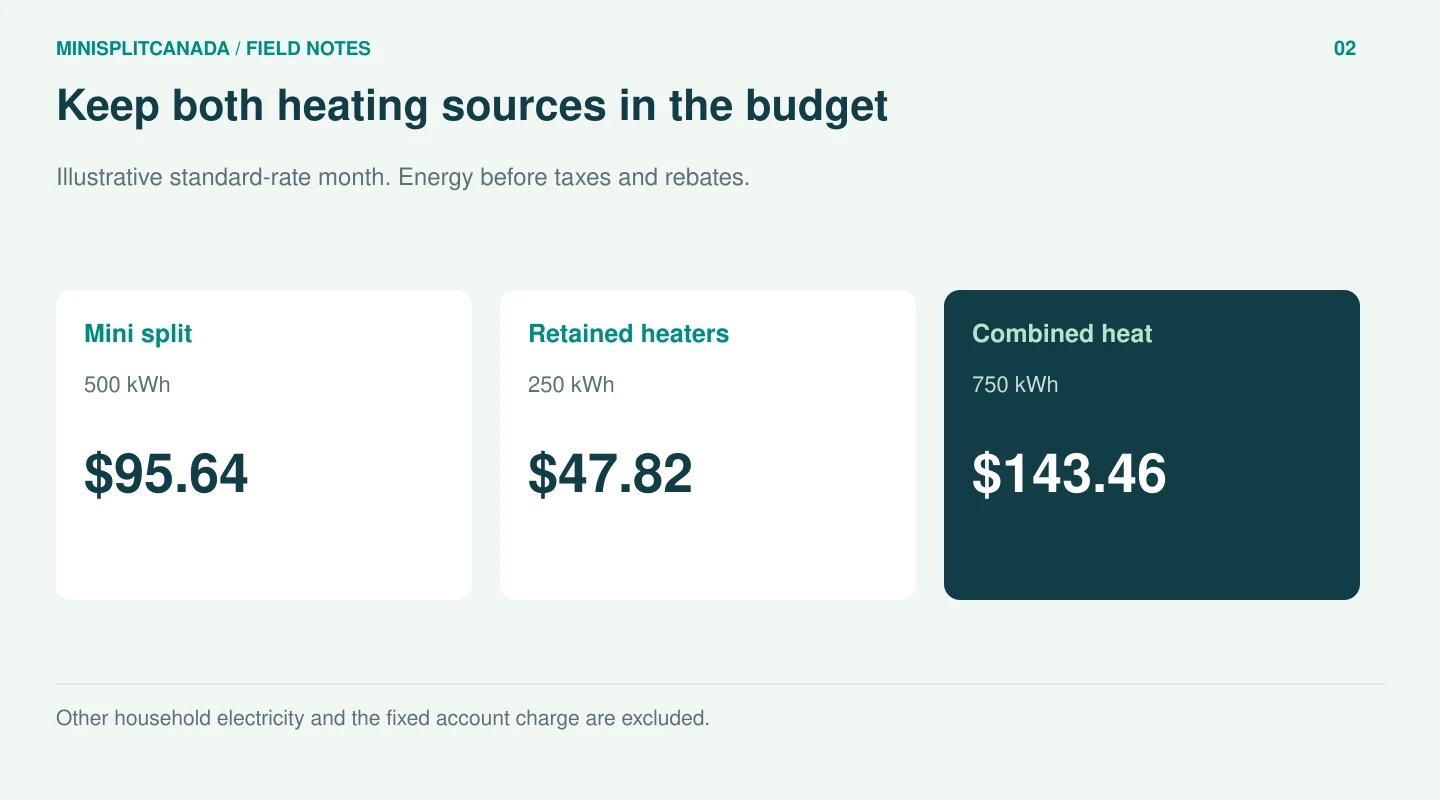
In an illustrative month, a mini split might use 500 kWh while retained electric heaters use 250 kWh. At the standard energy rate, those portions cost $95.64 and $47.82, for $143.46 combined. Other household loads and fixed charges remain separate.
Ask the designer for the exact equipment combination and its available output under the conditions used for the home. Then ask how the remaining heat is supplied and controlled. A low-temperature operating claim does not establish that every room’s heat requirement is met.
If the retained system uses fuel, budget its remaining consumption separately. The mini split’s electricity figure is not the complete heating cost. Keep the old and new comparison boundaries consistent, including rooms, comfort levels and any account charges that remain.
Efficiency Nova Scotia explains that heat pumps can temporarily enter a defrost cycle during heating. A brief change in airflow or operation can therefore be normal. The particular model’s instructions and the installer’s handover should explain what to expect.
There is no universal monthly defrost fee to add to the bill. Any effect on electricity should be reflected in the equipment’s operating estimate or measured consumption. Ask whether the calculation includes the full system and any separately powered accessories.
Keep outdoor airflow and drainage considerations in the installation discussion. Ask the contractor to explain the chosen location and the user-maintenance tasks. Do not attempt to force the equipment through a suspected problem based on an electricity estimate.
If heat remains inadequate, errors appear or icing persists, document the symptoms and seek service. Our icing guide addresses those concerns separately. A monthly bill can show that consumption changed, but it cannot identify a mechanical cause by itself.
For the first season, keep weekly notes alongside the utility’s consumption data. Record settings, occupied rooms, outdoor conditions and whether backup was used. Mark any unusual household loads, such as guests or electric vehicle charging.
Check the meter-reading dates and whether readings are actual or estimated. Divide kWh by days when periods differ. A larger total over a longer interval is not evidence that the mini split uses more energy each day.
Even daily averages need weather context. A colder week can require more heating while the equipment operates as intended. Compare the observations with the assumptions in the original estimate rather than with an unrelated household’s social-media bill.
For a direct equipment check, ask an installer or electrician about a suitable circuit energy monitor. Confirm whether it includes all outdoor and indoor components and any accessories. Label app-based figures as estimates unless their measurement basis is documented.
If you use an equal-billing arrangement, maintain a second record of actual consumption. A steady payment can coexist with a seasonal rise or fall in kWh, and a later reconciliation can affect the amount due. The payment arrangement helps household budgeting but does not measure the mini split’s performance.
When the annual worksheet is complete, compare its predicted kWh with the corresponding consumption periods before comparing dollars. Then apply the rates that were actually in force. This prevents a price change or account reconciliation from being mistaken for a heating-design error. Keep any changed payment amount in your cash-flow plan while preserving the consumption record for the contractor.
Give each contractor the same room plan, comfort target and description of existing heating. Request monthly kWh with backup separated, the tariff used and the limits of the estimate. Ask how a colder season or wider room coverage would change the result.
Keep purchase, servicing and financing outside the electricity column. Our Nova Scotia and Halifax cost guides address installation and service spending. Those costs belong in an ownership comparison, but combining them with energy before showing the parts makes quotations harder to assess.
MiniSplitCanada is an independent directory and guide publisher. It does not install or sell systems. Use the worksheet to compare explanations, verify the business’s service area and obtain a design for the actual home. The aim is a budget with traceable assumptions and a first-season record that can test them.
Before filing the estimate away, ask who will review unexpected results after commissioning. Keep that contact with the equipment documents and record the agreed follow-up process. A clear handover makes it easier to distinguish a changed household schedule from a setup issue that deserves a contractor’s attention.
Continue with Nova Scotia installation costs, Halifax installation costs, Canada installation costs.
Nova Scotia Power standard-service prices checked November 2, 2026. Seasonal totals use the number of months shown in the example. The calculations price electricity consumed by the heat pump before taxes, fixed fees and applicable rebates.
Review company information and request a proposal based on your rooms and heating needs.
Browse the directory →Ask an installer to assess the rooms, equipment, controls and retained heating.
Explore company information →
Join the conversation
Have a question about mini split electricity use and monthly costs? Leave a comment below.