
How much electricity does a mini split use, and what will that add to your bill? A meter reading answers the first question. Your local rate plan answers the second. Here is what the same 300 kWh costs across Canada’s ten provinces and how to estimate your own monthly use.
What does 300 kWh cost? At the residential rates compared below, the energy charge is $9.46 on Labrador Interconnected service, $29.91 on Manitoba Hydro and $57.38 on Nova Scotia Power’s standard plan. Fixed fees, sales taxes, credits and separately billed charges are outside the comparison.
How many kWh does a mini split use in a month? A unit averaging 0.5 kW across 12 operating hours a day uses 180 kWh in 30 days. A unit averaging 0.5 kW across all 24 hours uses 360 kWh. These are examples. The time span behind the average matters as much as the power reading.
For your own home, start with the heat pump’s measured kWh or an installer’s monthly estimate for the rooms it will serve. Find the utility and plan on your bill, then use the provincial guide for that rate.
The table prices a fixed amount of electricity so you can compare rates without assuming homes across Canada need the same amount of heat. Select your province for its winter and summer examples. Each guide also explains how to handle heating that stays on another system.
| Provincial guide | Utility and plan | Cents per kWh | Energy for 300 kWh |
|---|---|---|---|
| BC mini split electricity use and monthly costs | BC Hydro, residential flat rate | 12.70¢ | $38.10 |
| Alberta mini split electricity use and monthly costs | Calgary ENMAX / Edmonton EPCOR, Rate of Last Resort | 12.06¢ / 12.01¢ | $36.18 / $36.03 |
| Saskatchewan mini split electricity use and monthly costs | SaskPower, residential E01/E03 | 15.476¢ | $46.43 |
| Manitoba mini split electricity use and monthly costs | Manitoba Hydro, standard residential | 9.970¢ | $29.91 |
| Ontario mini split electricity use and monthly costs | OEB regulated tiered plan, all in Tier 1 or all in Tier 2 | 11.2¢ / 13.2¢ | $33.60–$39.60 |
| Quebec mini split electricity use and monthly costs | Hydro-Québec Rate D, all in first or second tier | 7.065¢ / 11.142¢ | $21.20–$33.43 |
| New Brunswick mini split electricity use and monthly costs | NB Power residential, including the variance charge | 15.84¢ | $47.52 |
| Nova Scotia mini split electricity use and monthly costs | Nova Scotia Power, standard residential | 19.128¢ | $57.38 |
| PEI mini split electricity use and monthly costs | Maritime Electric, first block / above 2,000 kWh | 17.84¢ / 14.23¢ | $53.52 / $42.69 |
| Newfoundland and Labrador mini split electricity use and monthly costs | Island Interconnected / Labrador Interconnected, standard domestic | 15.587¢ / 3.154¢ | $46.76 / $9.46 |
A range on a tiered plan shows what happens when all the added use falls at one price or the other. On a mixed bill, part falls in each block. Two amounts beside different utilities or systems are separate examples. An address in Labrador does not automatically qualify for the Labrador Interconnected rate.
Use the price for the supplier shown on your electricity bill. For example, the British Columbia row uses BC Hydro’s flat plan. A FortisBC electricity customer uses FortisBC’s tariff. Alberta’s examples use the default energy price for Calgary and Edmonton through December 2026. If you signed a retail contract, use its price and account for any delivery charges that vary with use.
A “12,000 BTU/h” label describes the heat the equipment can move under specified conditions. It does not tell you the electricity it draws over an afternoon. If you are getting a quote for a ductless system, ask for estimated electrical input for the selected outdoor unit and indoor heads at your local winter conditions.
On a flat plan, each additional kWh has the same published energy price. Tiered accounts work differently. In Quebec, for example, Rate D allows 40 kWh per billing day in the first tier. In a 30-day period that gives the entire account 1,200 kWh. If other loads use 1,100 kWh, only the first 100 of an added 300 kWh fits in that tier. The other 200 kWh falls in the second tier. Together those 300 kWh cost $29.35 before tax.
Ontario’s time-of-use price depends on the hour. At the November 2026 rates, a hypothetical 300 kWh split into 180 off-peak, 60 mid-peak and 60 on-peak costs $36.48 in energy. The tiered Ontario row above prices those same 300 kWh under a different plan. To decide between plans, include the home’s other electricity over the same dates and hours.
Check whether adjustments are already included. For example, NB Power’s published 15.84¢ residential price includes its 0.45¢ variance charge. Adding that charge a second time would overstate 300 kWh by $1.35. Fixed customer charges that you already pay are relevant to a full household budget, but adding another appliance to an existing service generally does not add a second customer charge.
Start with two questions. How much of the house will the mini split heat in winter? Which rooms will you cool in summer, and did they have air conditioning before? A downstairs head may do most of the winter work in an open living room, while bedrooms behind closed doors still need their own heaters.
| Operating period | Number of months | Heat pump kWh per month | Energy over the period |
|---|---|---|---|
| Colder heating months | 4 | 420 | $252.00 |
| Milder heating months | 3 | 150 | $67.50 |
| Summer cooling | 2 | 75 | $22.50 |
| No use assumed | 3 | 0 | $0.00 |
This example totals 2,280 kWh and $342 across the year. Multiplying the coldest month by twelve would produce 5,040 kWh. The difference comes from the months assigned to each use. Fill in your own heating and cooling periods, then apply your bill’s rates to each one. If you used to open a window instead of running air conditioning, the summer cooling is a new electrical load.
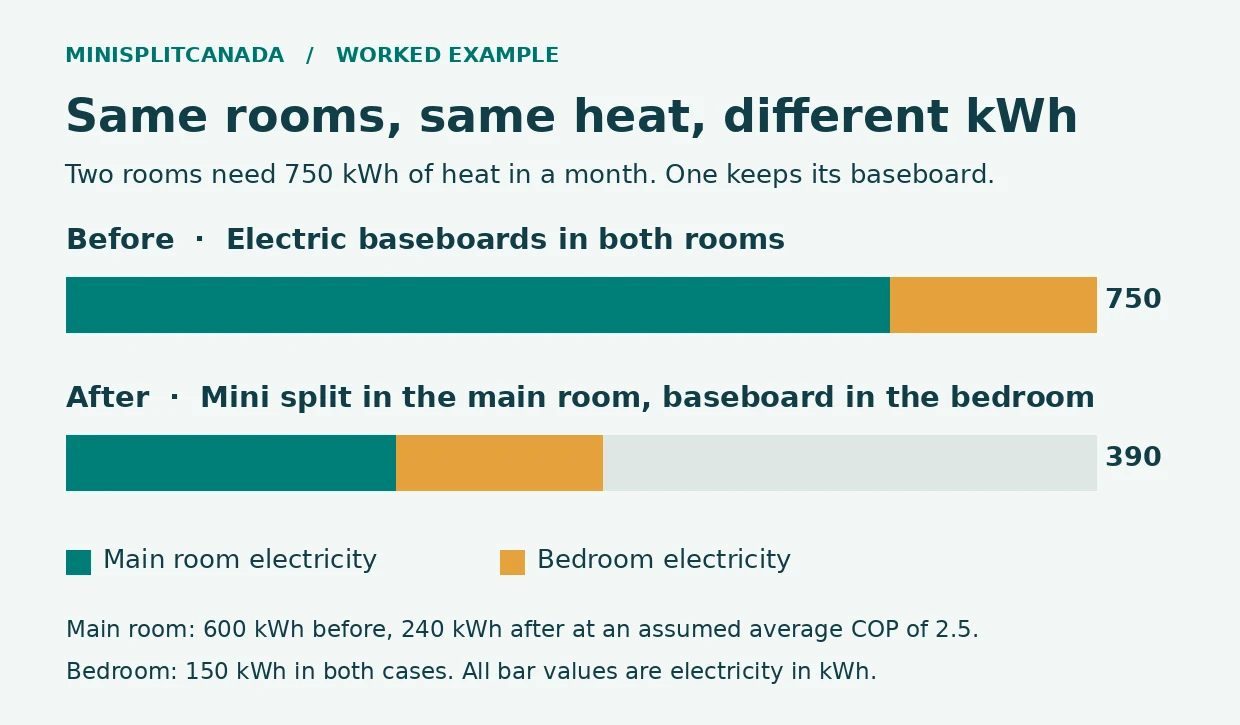
Suppose a main room requires 600 kWh of heat in one month and a bedroom needs another 150 kWh. Electric resistance heating for both rooms would use about 750 kWh of electricity. Now assume the main room gets a ductless heat pump that delivers an average of 2.5 units of heat per unit of electricity over the period. This ratio is the coefficient of performance, or COP.
The heat pump uses 600 ÷ 2.5 = 240 kWh. The bedroom baseboard still uses 150 kWh, so the two rooms together use 390 kWh. For the same assumed heat demand, the difference is 360 kWh. At a flat 15¢ per kWh that would be $54 in energy savings. Actual performance changes with the temperature and the equipment.
If your old heat came from oil or gas, keep two records. First price the electricity the heat pump and any remaining electric heaters use. Then compare fuel purchases over comparable heating periods. The household’s power bill can rise even if its total spending on heating falls.
Ask which rooms the indoor heads will heat with the doors in their usual positions. Request the winter heating load used for the estimate, the selected unit’s output at the local design temperature, and the assumption for backup heat. If a proposal promises one annual dollar amount, ask for the corresponding kWh. You can reprice those kWh if your utility changes its tariff.
After installation, keep the first complete billing period, the thermostat settings, and the dates the equipment was operating. Compare actual kWh per day for periods with similar weather. If the heat pump is separately metered, use that figure first. If only the whole-house meter is available, note changes such as an electric vehicle, visitors or a new water heater before attributing a difference to the mini split.
For a project budget, keep the upfront quote and recurring electricity on separate lines. The Canadian installation and service cost guide covers purchase and labour. Use the heat pump savings calculator to explore changes to your current heating costs.
Residential energy prices checked November 2, 2026. Figures are in Canadian dollars and rounded once per example. The 300 kWh comparison uses the rates named in each row, including adjustments built into a published price. It excludes fixed charges, separate delivery and regulatory charges, taxes and household-specific rebates. Consumption scenarios are illustrative. The table covers the ten provinces.
Review company information and request a proposal based on your rooms and heating needs.
Browse the directory →Ask an installer to assess the rooms, equipment, controls and retained heating.
Explore company information →
Join the conversation
Which utility and rate plan are you using for your estimate? Leave a comment below.