
Greenfoot publishes CAD $3,500–$6,500 for single-zone mini split installation and $8,000–$16,000 for multi-zone systems across its wider service area. These are regional provider examples, not a measured New Brunswick average; tax treatment is unstated. For local cleaning, Reliable Energy lists $170 plus HST for one unit and $320 plus HST for two in Moncton, Dieppe and Riverview. Checked October 15, 2026.
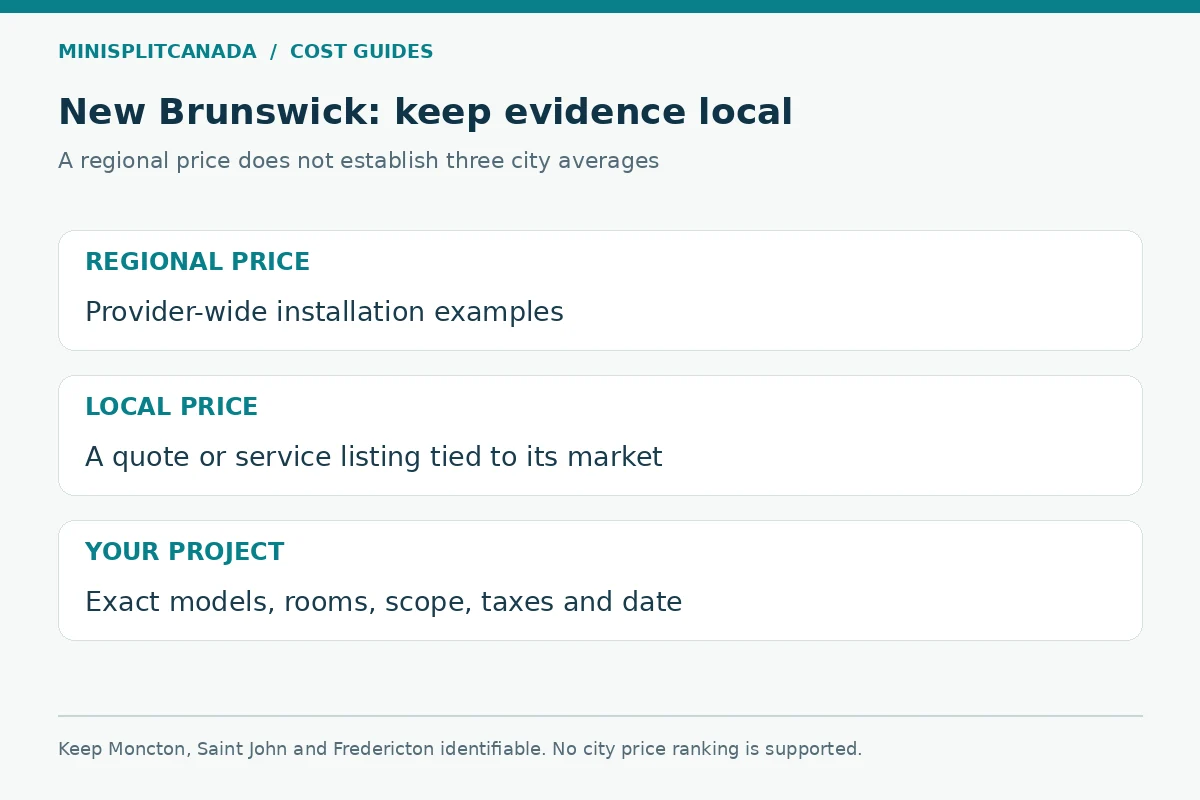
A New Brunswick ductless budget should distinguish partial heating from a project intended to serve the whole home. It should also keep Moncton, Saint John and Fredericton evidence identifiable instead of pooling unrelated prices into one provincial range.
Sources reviewed October 15, 2026Start by naming the rooms the system must serve. An open living area, several closed bedrooms and multiple floors create different distribution questions. Ask the designer to explain the intended coverage rather than assume that a large nominal capacity reaches every occupied room.
For supplemental heating, record which existing system remains and where it continues to serve the home. For a larger heating conversion, ask for the load assessment, low-temperature output information and backup plan. NRCan’s sizing toolkit provides a professional framework for these decisions.
If the project removes an old heating system, price that work explicitly. Associated electrical changes, disposal and any replacement of other functions should not disappear into a vague heat pump package. Compare proposals at the same heating objective before judging the number at the bottom.
Greenfoot’s mini split service page supplies the regional installation examples above. Its single-zone and multi-zone categories are useful context, but they do not provide matched quotations for the same home in Moncton, Saint John and Fredericton.
Daikin Atlantic’s Greenfoot Moncton listing describes an assessment followed by a project quotation. The corresponding Saint John listing follows the same approach. Neither listing turns the broader regional range into an independently observed city price.
This review did not establish three comparable local installation samples for each market. We therefore do not declare one city cheaper or calculate a provincial average. Obtain proposals for the same equipment class, room coverage and scope, and keep the actual location attached to every price.
Reliable Energy lists the Moncton-area cleaning rates above. Seal’s Heat Pump Cleaning publishes a deep-clean starting price of $149.99 plus tax. These are independent local examples, but their advertised scopes and price structures are not identical.
The Reliable Energy two-unit total implies an additional $150 before HST compared with its one-unit visit. That is an arithmetic difference within the published two-unit package, not a promise that every third or fourth head will cost the same amount. Ask for the complete quotation for the actual head count.
| Evidence | Published CAD figure | Geographic and scope limit |
|---|---|---|
| Greenfoot installation | One zone $3,500–$6,500 | Wider service area; exact site and tax to confirm |
| Greenfoot multi-zone | $8,000–$16,000 | Regional category, not three city samples |
| Reliable Energy cleaning | One $170; two $320, plus HST | Moncton, Dieppe and Riverview service listing |
| Seal’s deep clean | From $149.99 plus tax | Moncton provider starting price |
A Fredericton homeowner should request a local service total rather than adopt the Moncton cleaning rate. Likewise, a contractor’s regional coverage does not establish that travel, access and minimum-call charges are identical at every address.
The official SaveEnergyNB OHPA page says registration closed June 30, 2026. A new purchaser should not budget on the assumption that the former advance-payment route remains open. Existing participants need to follow the requirements and deadlines for their own file.
The same official page directs readers toward other available programs. Check the appropriate route before ordering equipment or starting work, and obtain confirmation of the steps relevant to your household. A contractor’s older advertisement is not proof that a program is accepting new applications.
Keep the gross installation price, tax and any confirmed assistance separate. If an estimate shows a net price, ask for the complete calculation and the conditions behind it. This avoids comparing an unconditional cash total with another offer that depends on eligibility that has not been established.
Ask the contractor whether assessment, installation and later service visits use the same coverage area. Record travel charges or minimum visit fees where applicable. A favourable installation package is easier to evaluate when the owner also knows who will support the equipment afterward.
Discuss the outdoor position and line route during the assessment. Ask about mounting, wall penetrations, drainage, visible covers and finish restoration. Identify any electrical work that will be invoiced by another trade. A fixed equipment price should not hide unresolved site allowances.
For multi-level homes, ask for a room schedule and head locations. If the configuration changes during design, request the revised model pairing and price before ordering. An additional head is not simply a cleaning-style per-unit charge; compatibility and installation scope need to be checked together.
For an owner outside a provider’s main dispatch area, ask how a warranty-related return visit is arranged. Clarify whether travel, diagnosis and labour are treated separately from covered parts, and request the applicable terms. This does not imply that rural addresses necessarily cost more. It simply makes the service arrangement visible before a regional installation offer is accepted, especially when competing contractors have different service bases or use different repair partners.
For a deep clean, confirm the coil, blower, filters, drain pan and drainage checks, plus any outdoor-unit work. For routine maintenance, ask which inspections are included. Specify access constraints and the number of heads so the booking matches the equipment at the property.
For a fault, obtain a diagnosis and an approved repair price rather than assuming cleaning will resolve it. Ask about applicable warranty, parts availability and testing after repair. There is no verified province-wide repair tariff in the evidence used for this guide.
A replacement quote should include removal, disposal and assessment of retained lines, wiring and supports. Compare the same room coverage first, then consider any expansion separately. MiniSplitCanada is an independent directory; the Canadian cost guide offers broader context, while a complete local proposal establishes what you will actually purchase.
Before requesting prices, prepare a short project brief with the rooms, existing heating, electrical information available to you and any access concerns. Ask bidders to respond to that same brief. If a contractor recommends a different approach, ask for the reason and a separate scope so it can be compared fairly.
At completion, retain the equipment identifiers, invoice, commissioning information and warranty documents. Ask the installer to demonstrate controls and explain the homeowner maintenance tasks for the selected model. Confirm who handles an urgent fault and whether service is provided directly or through another company. Those practical arrangements matter when choosing between otherwise similar proposals, even when no public price is available for future repairs.
Review company information and confirm current service coverage.
Browse the directory →Ask an installer to assess your rooms, equipment and installation scope.
Explore company information →
Join the conversation
Have a question about a quote or service scope? Leave a comment below.