
Hamilton ductless installation examples include CAD $4,000–$7,000 for one head and $7,500–$11,000 for two zones at ZK Mechanical. Hamilton Heating and Cooling publishes $4,500–$7,000 for a cold-climate single zone and $9,000–$16,000 for two or three heads. Voltly lists selected standard installed packages at lower prices, including a TCL 12,000-BTU system at $2,352. These are different specifications, not equivalent bids. Taxes and additional work must be confirmed. Checked October 15, 2026.
A verified Hamilton first-head and extra-head cleaning price was not established in this review. Request that service separately. For installation, distinguish a single addition from a retrofit across several rooms before choosing a price benchmark.
Sources reviewed October 15, 2026Imagine a finished addition that stays uncomfortable while the original house works adequately. The first quote should define that room’s heating and cooling requirement, indoor unit position and route to the outdoor equipment. It should not silently expand into a whole-house replacement simply because a larger package is available.
Tell the estimator how the addition is used and whether doors to the original house usually remain open. Discuss glazing, insulation and the existing heating arrangement during the assessment. Ask for the reasoning behind the selected capacity instead of buying the next size up as a precaution.
An addition can also complicate the route to the electrical supply and outdoor unit. Ask the contractor to identify finished areas that need to be opened, visible covers and reinstatement work. The original house and addition may have different construction details; the quote should describe the actual wall being penetrated rather than assume a standard material.
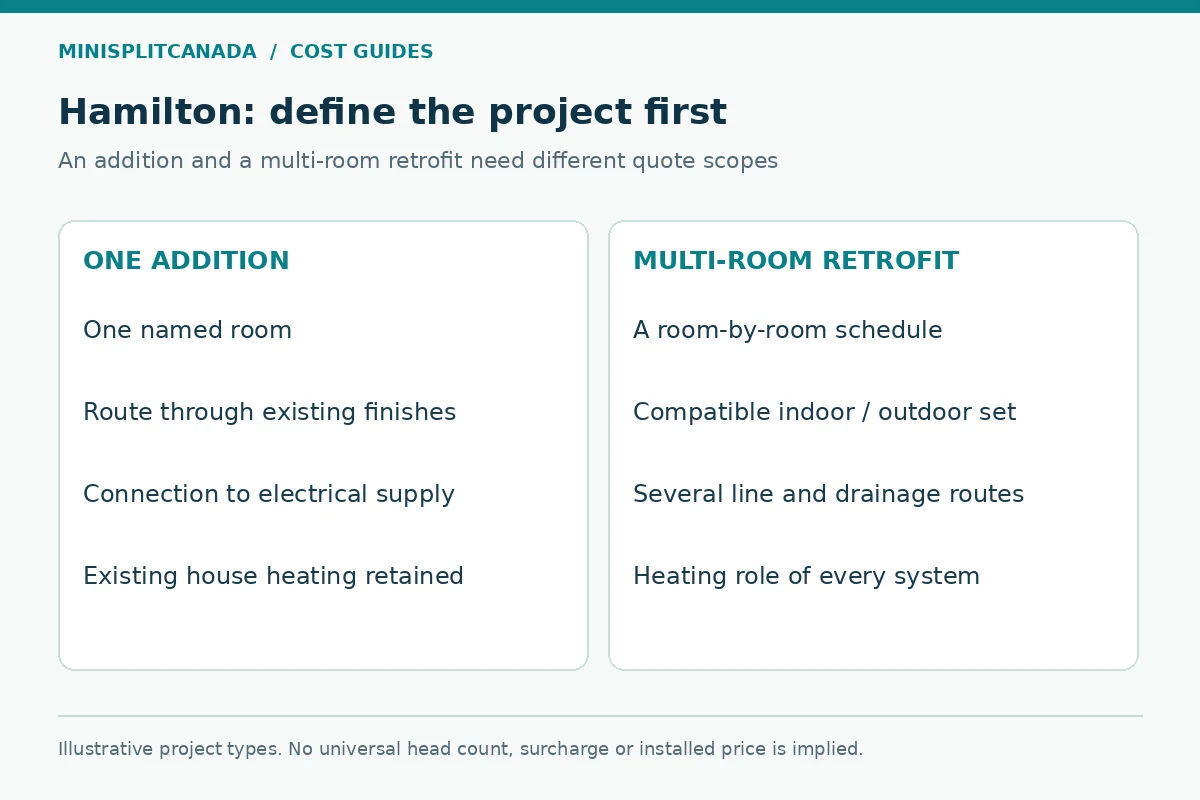
For an illustrative older home retaining radiators, the question is which rooms need direct ductless service. Make a room list with normal door positions and occupancy. Ask whether a landing head is expected to serve closed bedrooms and how the designer will assess that expectation.
A multi-zone system is not priced by multiplying the cost of one indoor head. The outdoor equipment, compatible combinations, line routes and installation labour form one designed package. Ask the estimator to identify each indoor model and location alongside the outdoor model so another contractor can quote comparable coverage.
If winter heating is part of the objective, request a load assessment and model-specific low-temperature output information. NRCan’s professional sizing toolkit explains the selection process. Keep retained heating and any proposed control changes in the written scope rather than assuming a mini split automatically replaces every radiator.
ZK Mechanical’s Hamilton page lists one head at $4,000–$7,000, two zones at $7,500–$11,000 and three or four at $10,000–$16,000 or more. Its ductless figures should not be confused with the ducted systems discussed on the same page.
Hamilton Heating and Cooling separately identifies cold-climate ductless examples. Voltly’s Hamilton selector includes a TCL BreezeIN 12,000-BTU H12SBH23XPC/XPE package at $2,352 with standard installation. That listing alone does not establish equivalence with a cold-climate heating design.
| Published example | CAD price | Qualification |
|---|---|---|
| ZK, single head | $4,000–$7,000 | Contractor range; exact model unspecified |
| Hamilton Heating and Cooling, cold-climate single zone | $4,500–$7,000 | Published 9,000–18,000-BTU category |
| Voltly, named TCL 12,000-BTU package | $2,352 | Standard installed listing; site extras need confirmation |
Three independent providers are represented, but these are not three matched quotations. Tax treatment is unstated in the extracted price examples. Ask each bidder to identify included electrical work, line length, mounting, startup and exclusions before comparing the final totals.
During the site visit, follow the proposed route from the electrical supply to the outdoor equipment and onward to each room. Ask which portions are firm-priced and which are allowances. An allowance should identify what remains unknown and how a revised amount will be agreed.
Discuss outdoor servicing access as well as installation access. Equipment that can be placed in a location may still require a different arrangement for routine maintenance or eventual replacement. Ask how the model’s requirements and site conditions affect the proposed support and position.
Do not assume an older property necessarily requires a service upgrade, or that a newer panel necessarily has sufficient capacity. Obtain a property-specific electrical assessment. Ask who handles applicable permits and inspections, whether another trade invoices separately, and how that amount is included in the total you are comparing.
Ask for a marked-up route sketch when the addition is separated from the electrical supply by finished rooms. Identify access panels, interior covers and any surfaces that another contractor must repair. If the homeowner will arrange finishing separately, request a clear handover condition: what openings remain, when the finishing trade can attend and which portions must stay accessible. This makes the excluded work concrete enough to budget and prevents a small installation allowance from concealing a separate renovation task.
The installation sources above do not establish a Hamilton cleaning tariff. Request a first-head price, the rate for each additional head during the same visit, and any minimum call-out charge. Confirm tax, travel, outdoor-unit work and difficult-access charges instead of importing a Toronto or Burlington cleaning price.
For a deep clean, ask whether the coil, blower, filters, drain pan and drainage path are addressed. For maintenance, ask which operating checks are included. Those descriptions let you compare services without assuming that every package called a tune-up includes the same work.
Describe symptoms before booking. A leak, persistent icing or an error display may need fault diagnosis, and cleaning should not be sold as a guaranteed cure. Agree the diagnostic fee and the approval process for parts and labour. Retain the report so a future repair provider can see what was checked.
If the existing equipment fails, obtain a repair diagnosis before treating age alone as a replacement decision. Ask about parts availability, applicable warranty and the full tested repair cost. A local repair price cannot be inferred from the cost of installing a new package.
For replacement, confirm removal, disposal and assessment of existing lines, drains, supports and electrical equipment. Ask which components are being retained and why they are compatible with the new matched system. Price relocation or additional rooms as separate options rather than burying them in the basic replacement total.
For eligible Ontario projects, the Home Renovation Savings program requires pre-approval before installation. Confirm the property and equipment with a participating contractor. Compare gross prices first and keep any conditional assistance separate from the cash needed to complete the work.
MiniSplitCanada is an independent directory. Use the Canadian mini split cost guide for wider context, then request Hamilton proposals that answer the addition or retrofit question you actually need resolved. The most useful quote names the rooms, equipment, installation tasks and exclusions in plain language.
Review company information and confirm current service coverage.
Browse the directory →Ask an installer to assess your rooms, equipment and installation scope.
Explore company information →
Join the conversation
Have a question about a quote or service scope? Leave a comment below.